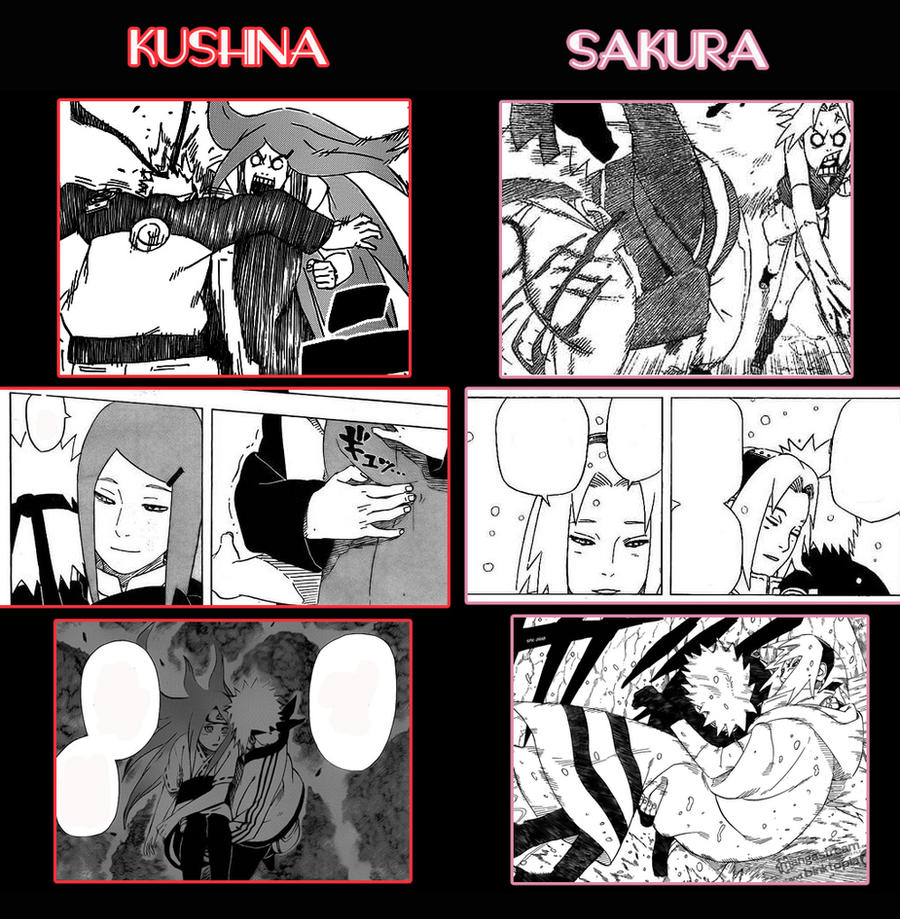
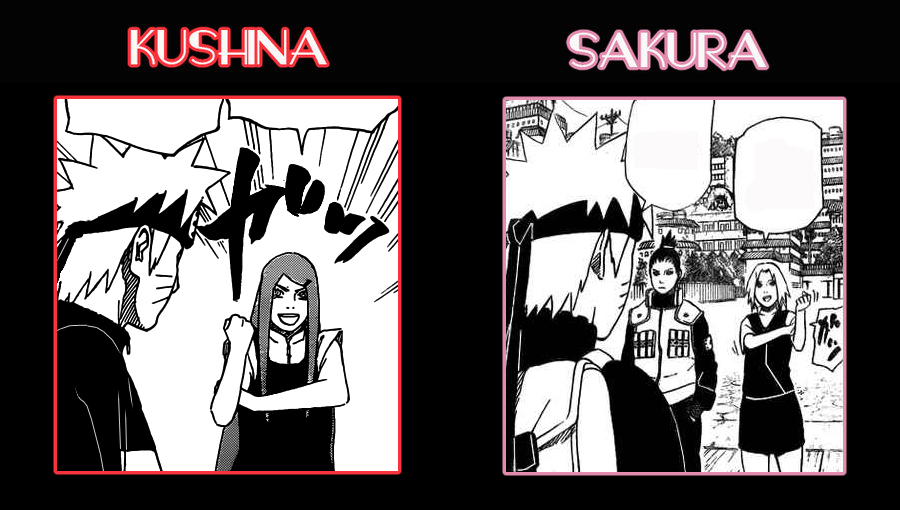
What's interesting to me is that in the whole story so far, Naruto has only made one comment to Hinata (that I can remember off the top of my head) about how he feels about her as a girl/person -- the infamous "I like people like you" back near the beginning of Part I. Everything else has been pep talky stuff -- that she's strong, etc.
By contrast, he has made many more personal comments to and about his appreciation for Sakura -- and missed obvious ones, such as when she asked him if she looked more womanly, lol.
Two of those comments were specifically about liking Sakura in a special way: (1) in #3 when he said "I feel like I finally understand why I love her" (official English Jump translation says "love" not "like"); and (2) his implicit admission that he loves her when questioned by Sai.
There is an ocean of difference between "I like people like [Hinata]" and "I feel like I finally understand why I love [Sakura]." Just saying.
Warning: my Japanese is less than perfect so do not take any of this as your new God-given truth.

First of all: does anyone of you actually have any links to the Japanese original chapters? I tried the Google, but it failed me!

Lacking the originals, I would hazard a guess that in both cases described above the verb used is 好き (suki) or in the NS scene possibly 大好 (daisuki). Japanese is a tricky language because so much depends on the context. For example, "daisuki" can mean both "loves" or just "really likes"*. I have seen quite many people think that the word that means the truly true romantic love is 愛してる (aikitteneru). But this is, as far as my understanding goes, more formal than the others and therefore used less. Also, it can mean just platonic love because Itachi uses (according to the mighty Wikipedia, anyway) the word aikitteneru when he says he loves Sasuke. Also, it is my understanding and the way I remember from the anime, that in quite many scenes the characters just trail off before they even reach the word love. Like in the Yamato-Sakura scene, Yamato never even has the time to select the verb such as aikitteneru. Yay Japanese.

The reason those translations vary so much is probably because the translators are using whatever they feel is (or guess to be) the appropriate word (likes, loves, really likes) and haven't got a fixed preference for any word.
*Except, not really, because "suki/daisuki" are not even verbs. They are just translated that way because otherwise it wouldn't make much sense in English.
I've only just now begun to start learning Hiragana.
Good luck with your studies. Just wait til you get to the Kanji.

Edited by Poison_In_Your_Coffee, 03 January 2013 - 01:57 AM.



 This topic is locked